
People often think creativiteit is something that pops out of us fully formed, like a rabbit from a magician’s hat. But creativity is really a slow-blooming creature. It lurks in the corners of our attention, waiting for us to loosen our grip on who we think we are. Psychedelics, especially psilocybin, are very good at unclenching that grip.
At Wholecelium we love celebrating the weird, brave, imaginative parts of human experience, and few things spark those qualities like a mushroom journey. Yes, the colors shimmer, the boundaries wobble, and the mind takes off on a bicycle made of stardust. But the visions aren’t the end goal. They’re the opening credits.
The real movie begins when you dissolve and return.
In this way, a psychedelic experience is not just fuel for creativity. It is creativity itself, enacted in real time through perception, surrender, and reassembly. It is a creative process because you are the material, the sculptor, the paintbrush, and the canvas all at once.
Let’s explore why.

The Myth of “Instant Creativity”
There’s a long-running myth that psychedelics turn you into some sort of cosmic art fountain. That if you take enough mushrooms, you’ll start speaking in glowing poetry or producing masterpieces before breakfast. But that’s like believing eating spaghetti makes you fluent in Italian.
Sure, psilocybin can pull the velvet rope off your imagination. It can turn the volume up on your emotional world. It can loosen patterns you didn’t even know were patterns. But the visions themselves? They’re more like sketches from a dream architect. Blueprints, not buildings.
The creative magic isn’t that the mushrooms give you the answers. It’s that they blast open the walls of your mind so you can redesign the floor plan.
During a journey you might feel your “self” melt like candle wax. Your roles, anxieties, and storylines soften. But melting isn’t the creative moment. The melting just clears the table.
The building begins afterward.

Why “The Melt” Isn’t the Masterpiece
Anyone who has taken a larger dose of psilocybin — especially a "heroic" one — knows the part where reality really starts to splinter. Your sense of identity loosens. The usual grip you have on your name, your story, your opinions, your to-do list: gone like a sandcastle at high tide.
Some people resist this phase. Others surrender, lean forward, and fall through the curtain. Either way, the self you knew becomes soft around the edges.
But the melt isn’t the art. The melt is the primordial soup from which things evolve.
The art happens when you return, blinking in the sun of reality, and you start asking:
- What do I want to keep?
- What do I want to change?
- What new shape do I want to take?
This is why the first hours and days after a trip feel like walking around with fresh eyes. You see your life clearly, sometimes too clearly, like someone turned the brightness up on your relationships, habits, job, and secret desires.
Most people report a surge of tenderness and clarity. A sense that they’ve cracked a window in the dusty psychic attic. And that refreshing breeze is creativity in its rawest form.

Integration: The Real Studio Time
Think of a psychedelic journey as a creative spark. But sparks can go out if not tended.
Integration is that tending.
The first day or two:
You feel the afterglow. Your mind is soft clay. Everything feels a little more possible. You’re remembering the journey but also noticing the “you” that returned from it is different.
The first couple of weeks:
This is the golden window where your reactions slow down. You get a tiny pause — a space where creativity can live. Instead of brushing off your partner’s comment, or zoning out into your usual habit loop, you ask:
Is this the only way to respond?
That question is already creativity. You’re rewriting your reactions.
One to six months:
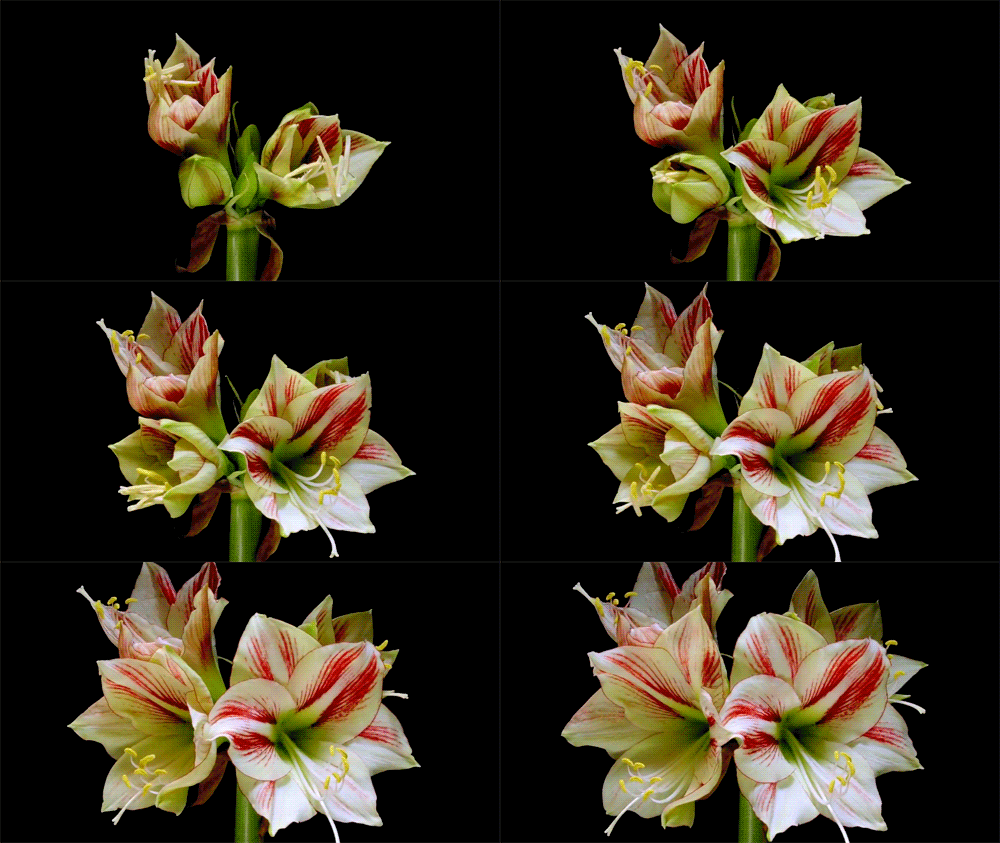
If the journey thawed the soil, integration is planting season.
This is where the real building occurs. New patterns form. New boundaries or softnesses appear. You name your new orientations. You may start to embody the promise you saw in the trip itself.
And because the material you’re working with is yourself, the art can take any form.
Creation doesn’t appear on a canvas. Sometimes it looks like finally being at one with yourself.
Why Science Struggles to Measure This
Scientists trying to measure creativity during a psychedelic trip are a bit like people checking bread dough when it’s only been in the oven for five minutes. Of course you’re not going to see a loaf yet.
Yes, brain scans show increased connectivity under psilocybin. Neural networks that rarely connect suddenly start collaborating. It’s a neurological jam session. But creativity — the true kind — comes in its own time.
Psilocybin studies often miss this because the real artistry happens in the days, weeks, and months after the journey. Good science requires timelines. Good art requires patience.

A Psychedelic Trip Is Its Own Creative Act
What makes a psychedelic journey fundamentally creative is not the outcome but the process. Creativity isn’t only about making a product. It’s also about reshaping perception, loosening assumptions, and confronting what hides under the floorboards of your own mind.
During a psilocybin trip you:
- improvise with your identity
- experiment with meaning
- let your imagination roam without a leash
- collaborate with your subconscious
- enter a story you didn’t write but can rewrite afterward
These are all creative acts.
You are generating new ways of seeing. That itself is art.
Final Thought
A psilocybin journey is not simply an experience you hebben. It’s an experience you maken. You initiate it, shape it, surrender to it, and eventually build from it. It is a creative cycle baked into consciousness itself.
Whether or not you produce any art afterward is beside the point. The art already happened.
You lived it.







 Dutch
Dutch  English
  Chinese
  Czech
Czech  Danish
  Estonian
  Finnish
  French
  German
  Hungarian
  Italian
  Japanese
  Latvian
  Lithuanian
  Polish
  Portuguese
  Romanian
  Slovak
  Slovenian
  Spanish
  Swedish